Calendar Curse
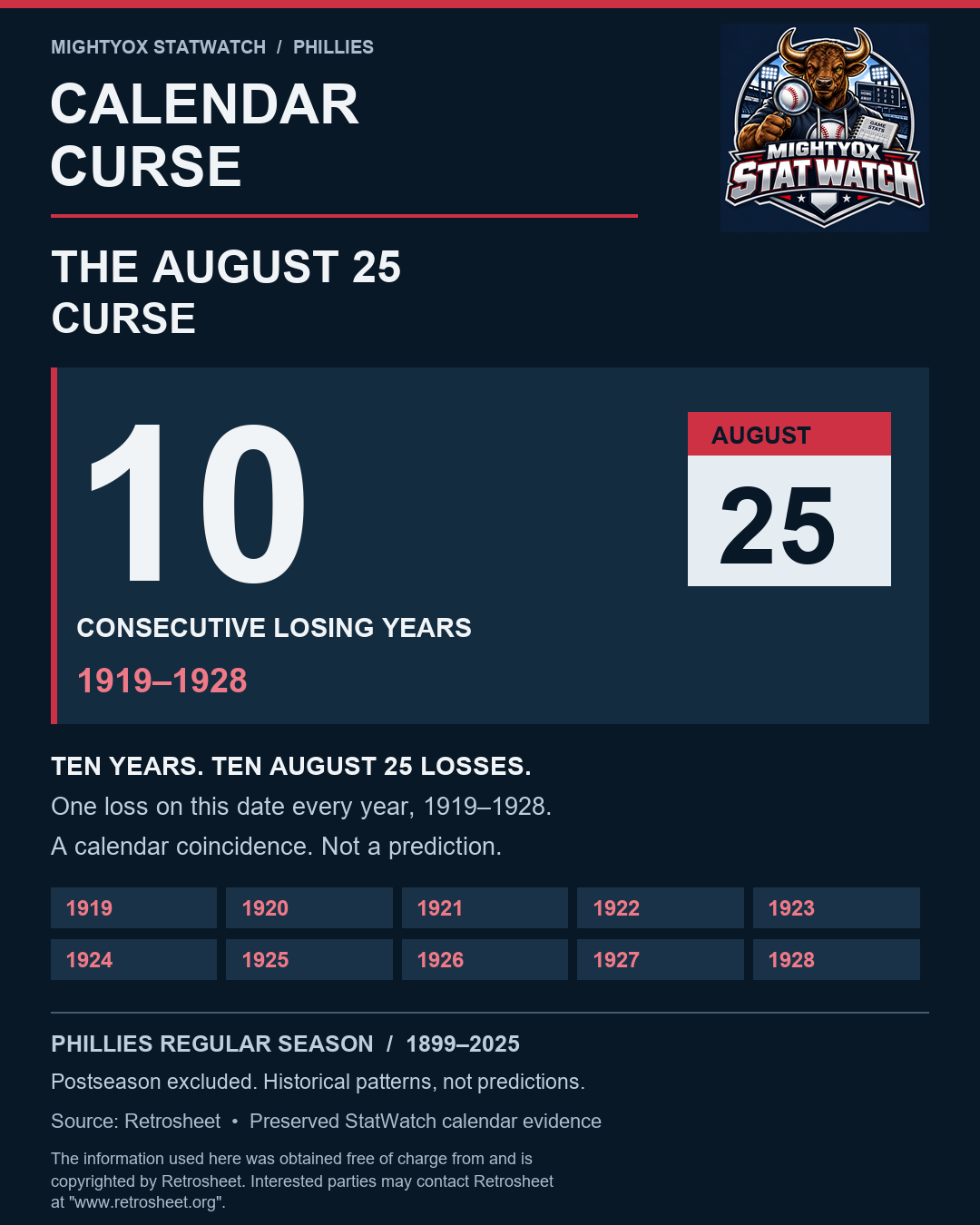
August 25: ten years without a win
From 1919 through 1928, the Phillies lost on August 25 every year—even when they scored 23 runs.
 MIGHTYOXSTATWATCHTHE NUMBERS HAVE STORIES.
PHILLIES / Calendar Curse
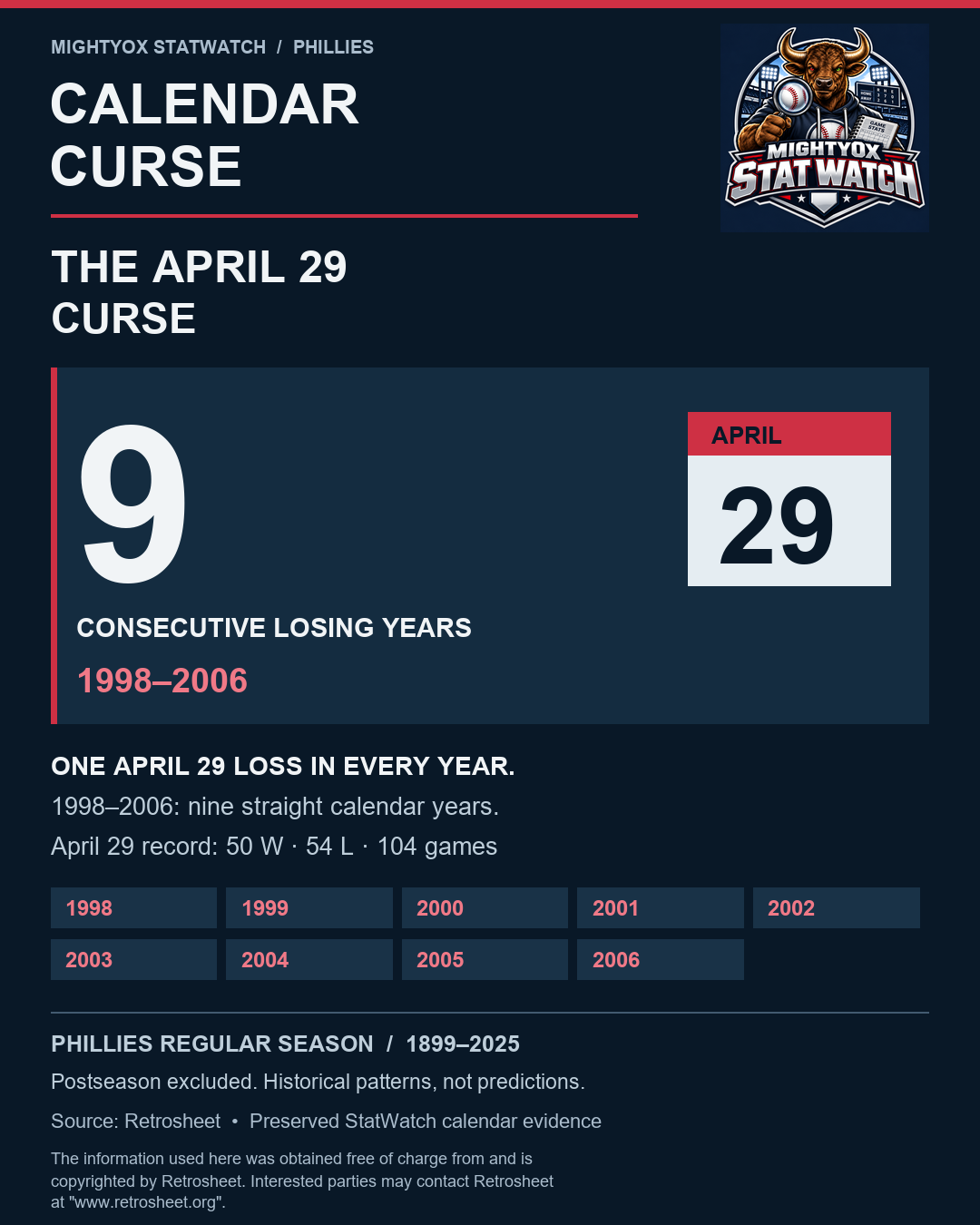
Nine years. Nine games. Nine losses. A calendar coincidence with an unusually stubborn streak.
Published · October 16, 2026
Some dates barely register on a baseball calendar. April 29 earned a second look. From 1998 through 2006, the Phillies played on that date in nine consecutive calendar years and lost every time. Different opponents, different scores, same letter in the results column. That is the kind of small historical oddity that makes StatWatch stop scrolling.
The run began with a 1–0 loss at Cincinnati in 1998. A year later, the Reds appeared again, this time in Philadelphia, and won 7–3. The calendar kept turning, but the result did not. St. Louis, Los Angeles, San Francisco, Florida and Pittsburgh also appear in the nine-game trail. Those are the opponent names recorded for the era; Florida is not silently relabeled Miami.
These were not nine identical games. Four were decided by one run: 1998, 2000, 2004 and 2006. The Phillies scored six runs against St. Louis in 2000 and still lost 7–6. They scored none in the opening game of the sequence. Across all nine games, Philadelphia scored 27 runs and allowed 47. The final scores offer plenty of contrast without inventing an inning-by-inning drama.
There are clear boundaries on both sides. The Phillies beat Pittsburgh 8–2 on April 29, 1997, before the stretch began. On April 29, 2007, they beat Florida 6–1. That makes 1998–2006 a closed nine-year sequence in the preserved record, rather than a streak still waiting for its ending.
Zoom out and the date looks much less ominous. In the qualified 1899–2025 regular-season population, the Phillies went 50–54 across 104 April 29 games. The nine losses belong inside that larger sample. They are not a reason to treat the next April 29 game as already decided. The word curse is our playful headline language, not an explanation of how baseball works.
The counting rule matters: one appearance on the date in each of nine adjacent calendar years, with every game a loss. There were nine games in this particular stretch, so no doubleheader changes the count. A missing year would break a consecutive-year run; a consecutive-appearance measure would instead skip that year. This article uses original source-assigned dates, excludes postseason games, and makes no claim about seasons before the qualified calendar baseline. Sometimes the calendar supplies the hook. The evidence still gets the last word.
CHECK THE RECORD
Phillies regular season1899–2025; postseason excluded
| Date | Opponent | PHI–Opp. | Result |
|---|---|---|---|
| 1998-04-29 | Cincinnati Reds | 0–1 | L |
| 1999-04-29 | Cincinnati Reds | 3–7 | L |
| 2000-04-29 | St. Louis Cardinals | 6–7 | L |
| 2001-04-29 | Los Angeles Dodgers | 1–4 | L |
| 2002-04-29 | San Francisco Giants | 5–8 | L |
| 2003-04-29 | Los Angeles Dodgers | 2–6 | L |
| 2004-04-29 | St. Louis Cardinals | 4–5 | L |
| 2005-04-29 | Florida Marlins | 4–6 | L |
| 2006-04-29 | Pittsburgh Pirates | 2–3 | L |
Original source-assigned dates govern. Calendar-year streaks require adjacent years; appearance streaks skip years without an appearance. All relevant games on a date must qualify. Adjacent boundaries and source-row references are retained in the evidence.
The information used here was obtained free of charge from and is copyrighted by Retrosheet. Interested parties may contact Retrosheet at "www.retrosheet.org".
Source organization · Detailed source records are retained for verification and corrections.
Historical patterns are not predictions. No unsupported player actions, quotations or inning-by-inning details are inferred.
Published after factual and editorial review. Correction policy and version notes.
Calendar Curse
From 1919 through 1928, the Phillies lost on August 25 every year—even when they scored 23 runs.
Calendar Magic
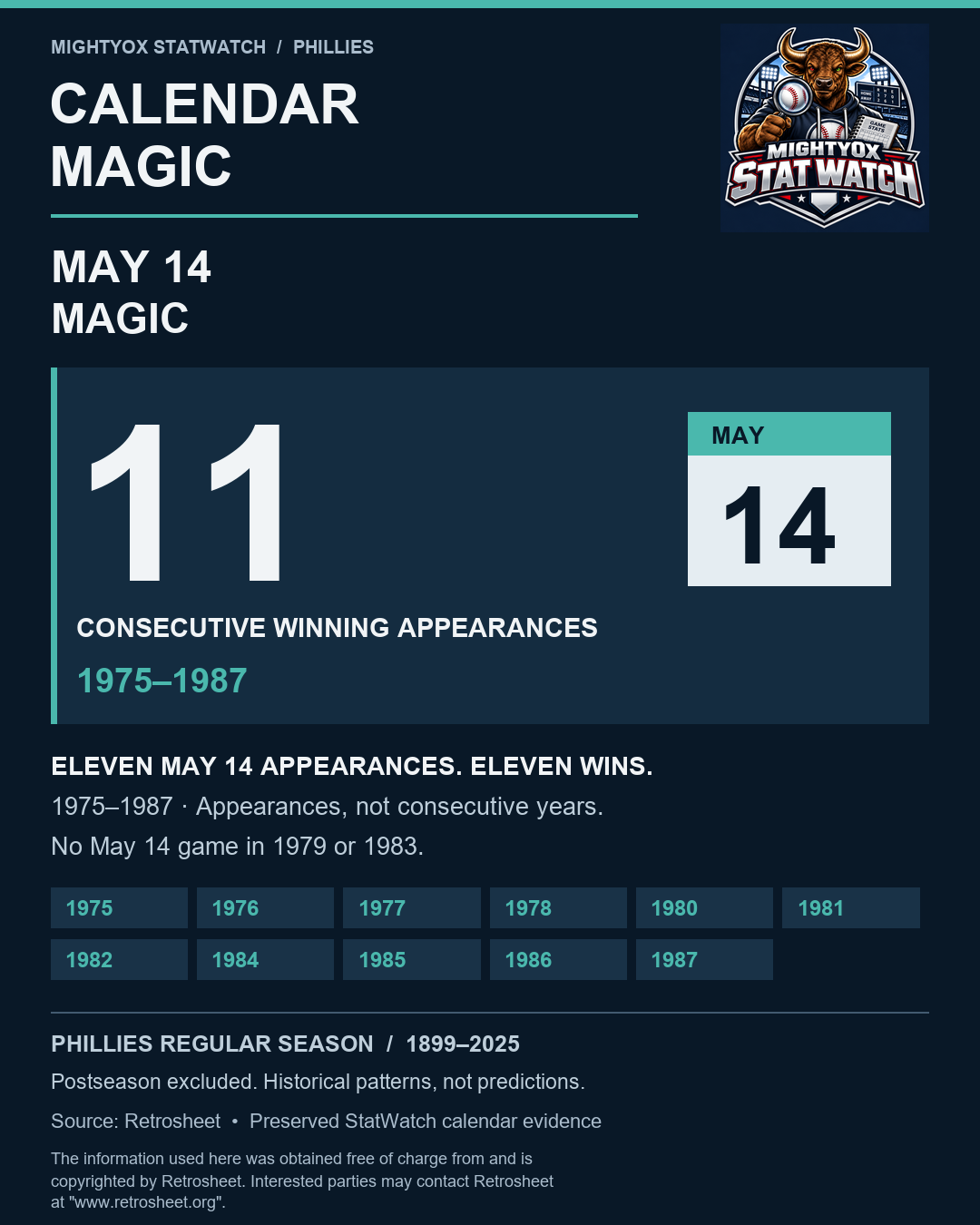
From 1975 through 1987, every Phillies appearance on May 14 ended in a win. Two missing dates make the counting rule part of the story.