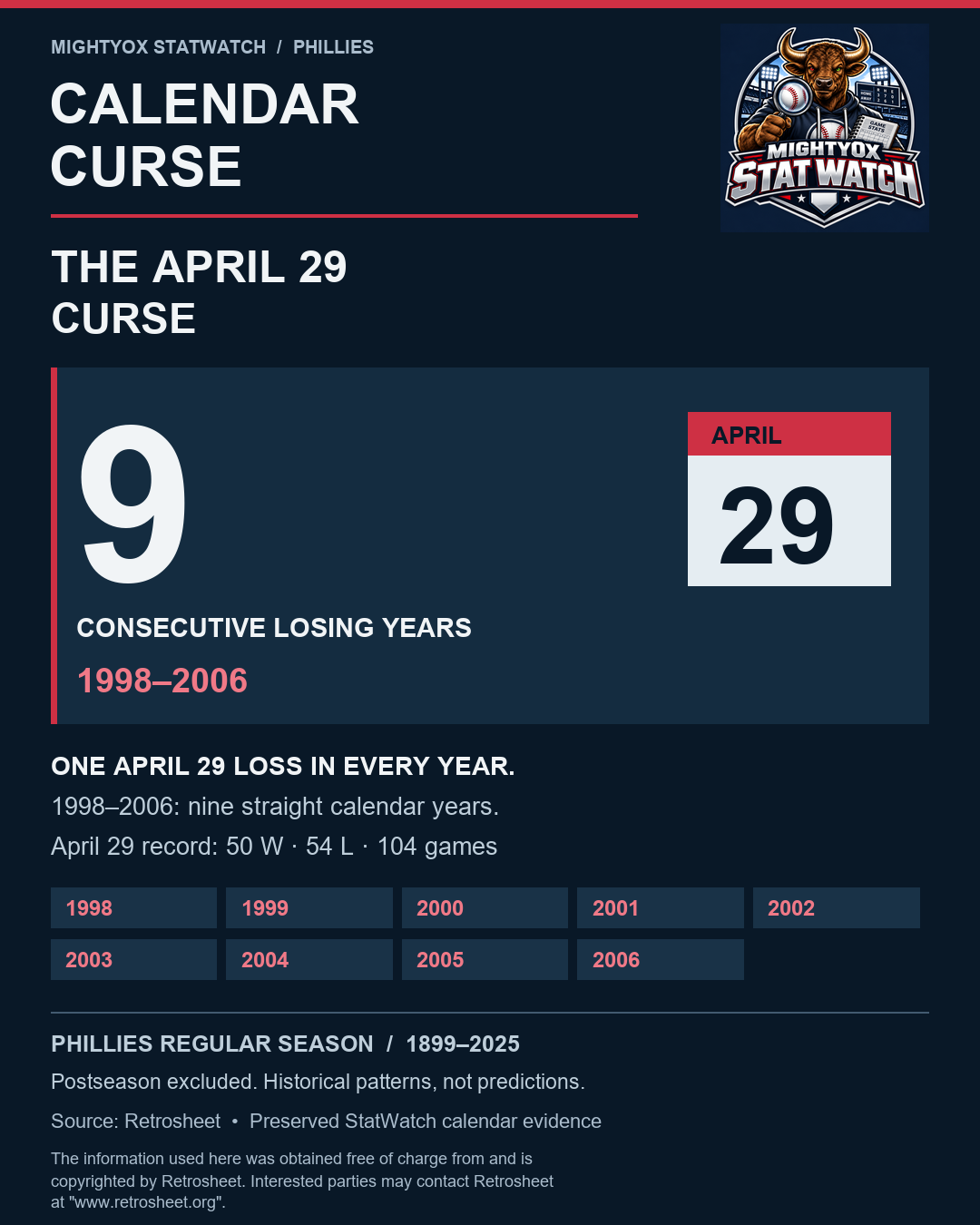
Calendar Curse
April 29: nine years, nine losses
Nine years. Nine games. Nine losses. A calendar coincidence with an unusually stubborn streak.
 MIGHTYOXSTATWATCHTHE NUMBERS HAVE STORIES.
PHILLIES / Calendar Curse
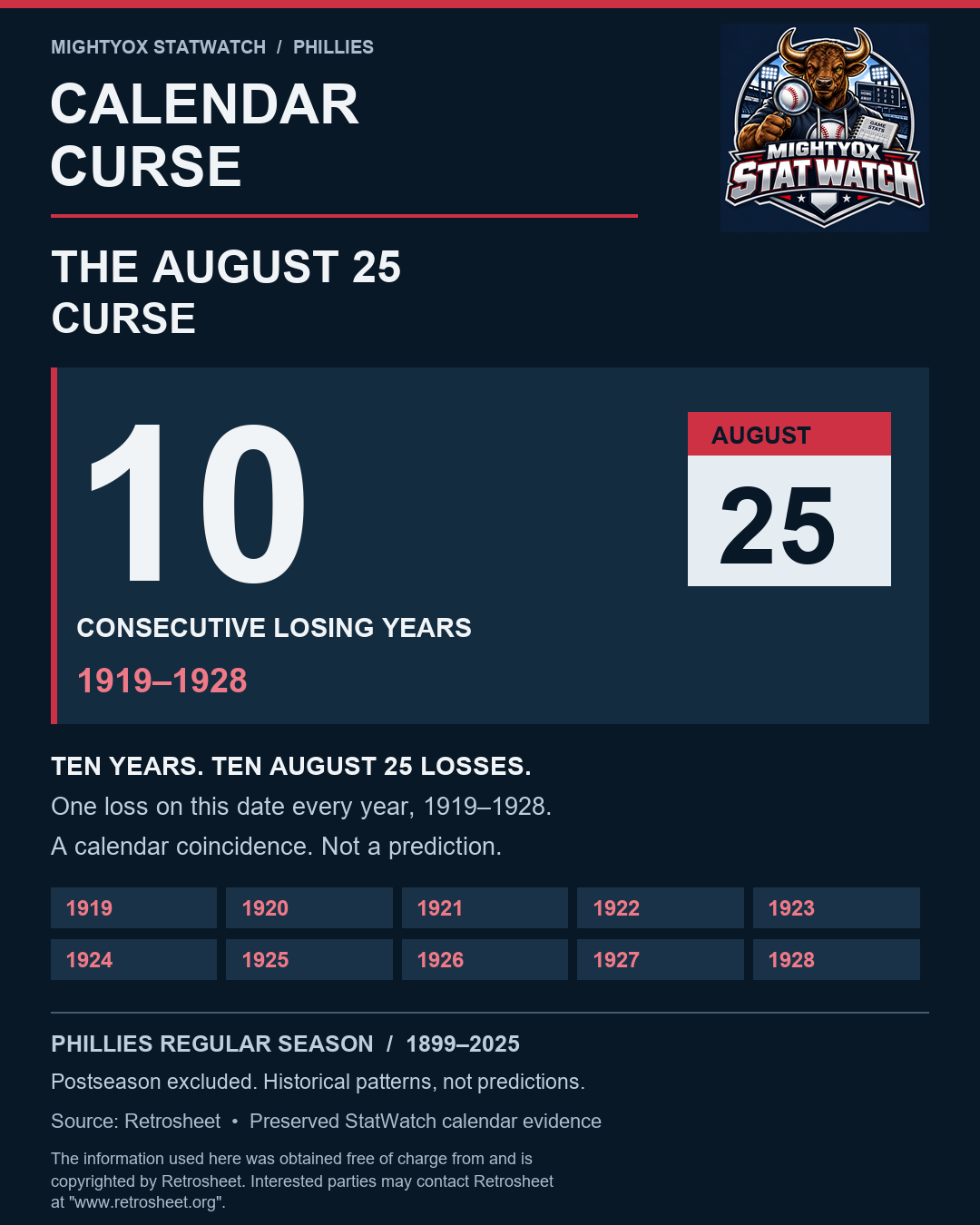
From 1919 through 1928, the Phillies lost on August 25 every year—even when they scored 23 runs.
Published · October 16, 2026
A losing streak can hide some very different baseball games. From 1919 through 1928, the Phillies played on August 25 in ten consecutive calendar years and lost every time. In one of those games, they scored 23 runs. The result still went in the loss column. That contrast is what makes this Calendar Curse worth opening up rather than reducing to a single number.
Cincinnati supplied the opponent in the first three years. Philadelphia lost 7–3 at home in 1919, 5–1 on the road in 1920, and 3–1 at home in 1921. The next August 25 brought a very different final score: the Phillies lost 26–23 to the Chicago Cubs in 1922. These preserved totals support the extraordinary score; they do not, by themselves, establish an MLB record or tell us what happened in each inning.
Chicago appears repeatedly in the remaining years. The Phillies lost 3–1 to the Cubs in 1923, 19–10 in 1925, 3–2 in 1926, and 8–0 in 1927. Between those Chicago games sits a 7–4 loss to Pittsburgh in 1924. The final game in the ten-year sequence was a 2–1 loss at St. Louis in 1928. A one-run margin and a game with 49 combined runs both belong to the same date-based finding.
Add the ten final scores and Philadelphia scored 46 runs while allowing 83. Those totals describe this selected sequence only. They are not season totals, an assessment of any individual player, or an explanation for why the losses happened. One game was played on each qualifying August 25, so ten consecutive losing years also means ten games in this particular interval.
The following August 25 broke the pattern: the Phillies beat the Brooklyn Robins 4–0 in 1929. On the other side, the preserved date stream has no Phillies appearance on August 25, 1918. That missing year matters because this measure requires adjacent calendar years; it cannot be extended backward by simply skipping a date without a game.
The finding belongs to the qualified 1899–2025 Phillies regular-season population. Postseason games and provisional earlier records are outside that scope. Curse is playful language for a memorable sequence, not a causal claim. The next game remains a new game, whatever the calendar says.
CHECK THE RECORD
Phillies regular season1899–2025; postseason excluded
| Date | Opponent | PHI–Opp. | Result |
|---|---|---|---|
| 1919-08-25 | Cincinnati Reds | 3–7 | L |
| 1920-08-25 | Cincinnati Reds | 1–5 | L |
| 1921-08-25 | Cincinnati Reds | 1–3 | L |
| 1922-08-25 | Chicago Cubs | 23–26 | L |
| 1923-08-25 | Chicago Cubs | 1–3 | L |
| 1924-08-25 | Pittsburgh Pirates | 4–7 | L |
| 1925-08-25 | Chicago Cubs | 10–19 | L |
| 1926-08-25 | Chicago Cubs | 2–3 | L |
| 1927-08-25 | Chicago Cubs | 0–8 | L |
| 1928-08-25 | St. Louis Cardinals | 1–2 | L |
Original source-assigned dates govern. Calendar-year streaks require adjacent years; appearance streaks skip years without an appearance. All relevant games on a date must qualify. Adjacent boundaries and source-row references are retained in the evidence.
The information used here was obtained free of charge from and is copyrighted by Retrosheet. Interested parties may contact Retrosheet at "www.retrosheet.org".
Source organization · Detailed source records are retained for verification and corrections.
Historical patterns are not predictions. No unsupported player actions, quotations or inning-by-inning details are inferred.
Published after factual and editorial review. Correction policy and version notes.
Calendar Curse
Nine years. Nine games. Nine losses. A calendar coincidence with an unusually stubborn streak.
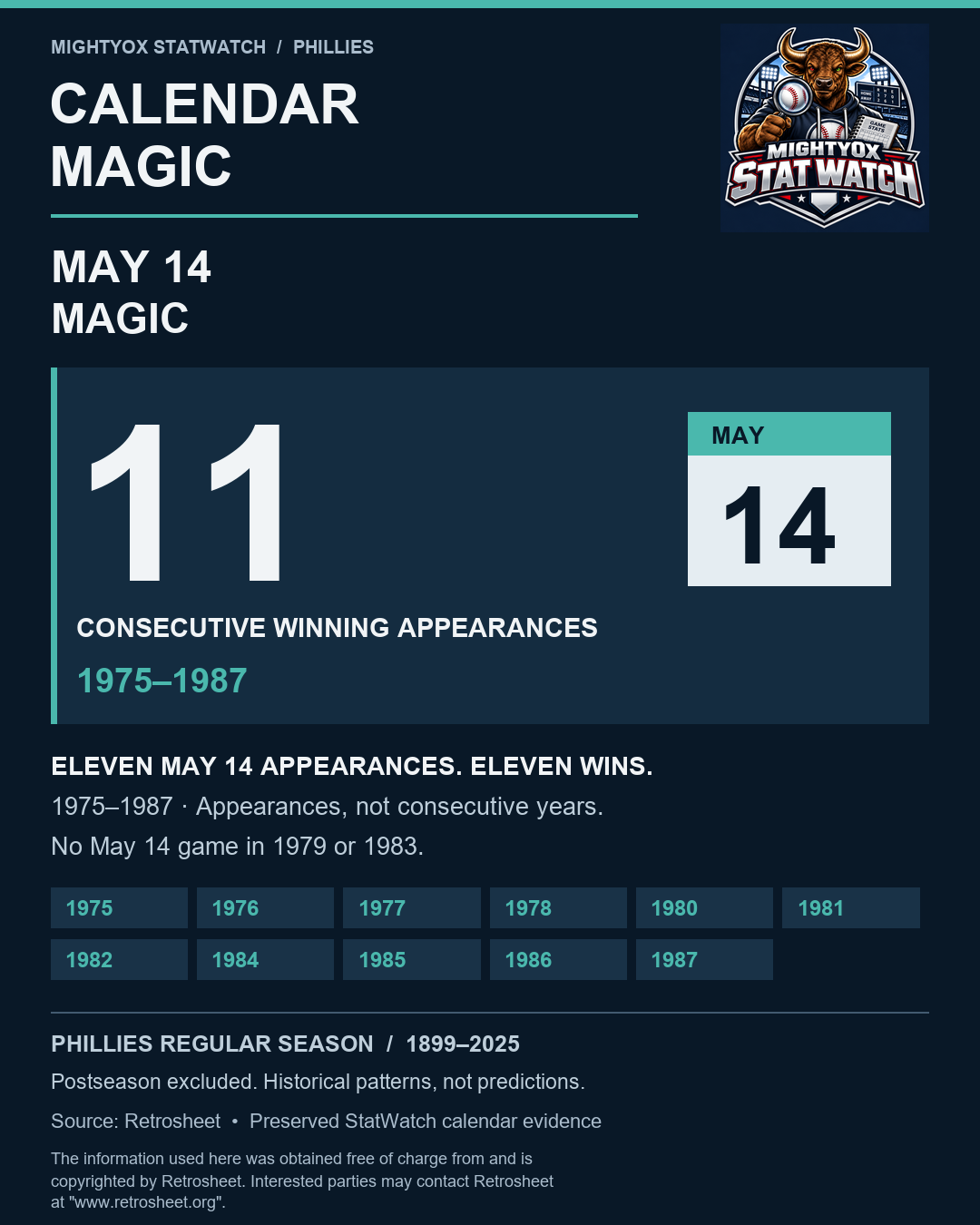
Calendar Magic
From 1975 through 1987, every Phillies appearance on May 14 ended in a win. Two missing dates make the counting rule part of the story.