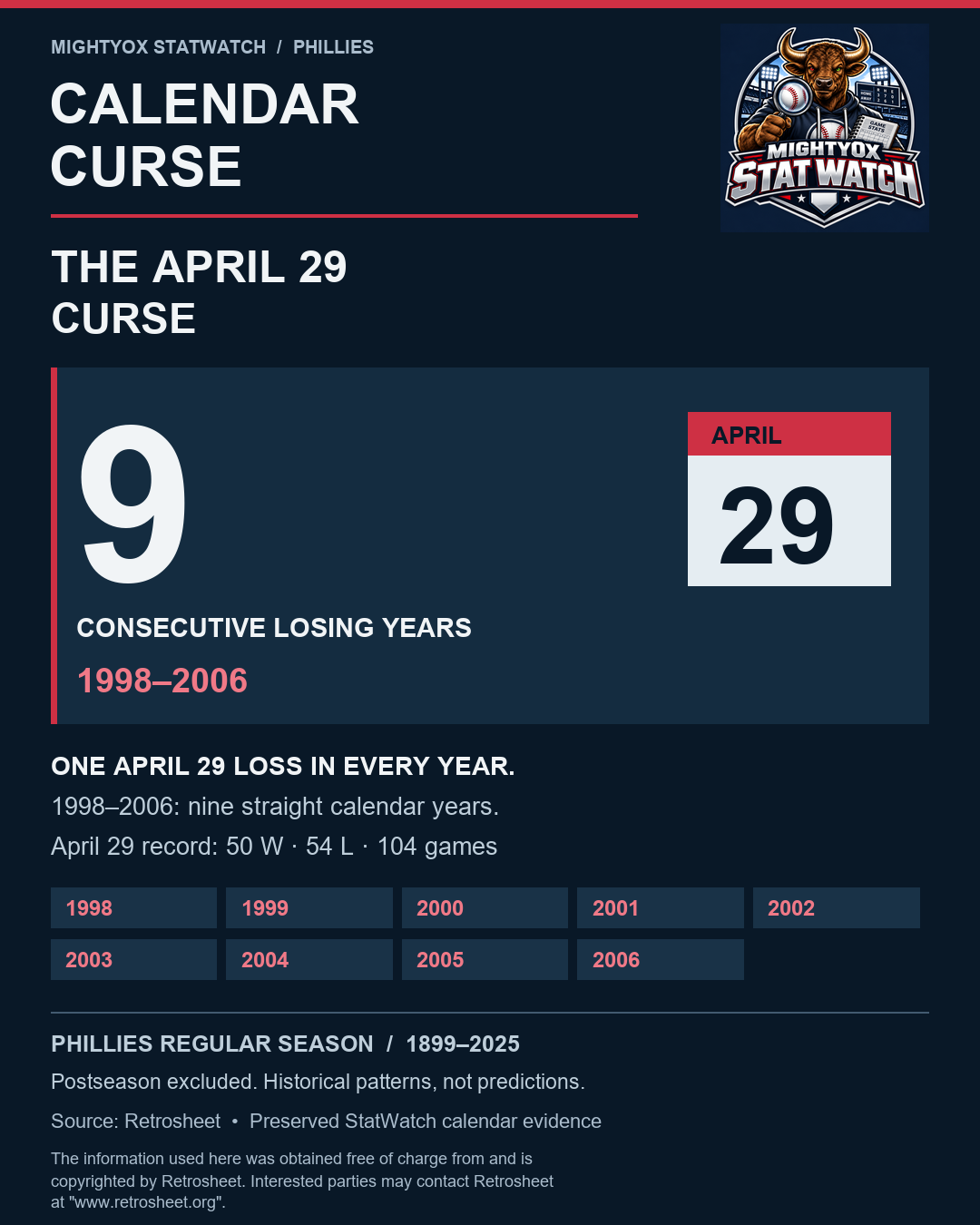
Calendar Curse
April 29: nine years, nine losses
Nine years. Nine games. Nine losses. A calendar coincidence with an unusually stubborn streak.
 MIGHTYOXSTATWATCHTHE NUMBERS HAVE STORIES.
PHILLIES / Calendar Magic
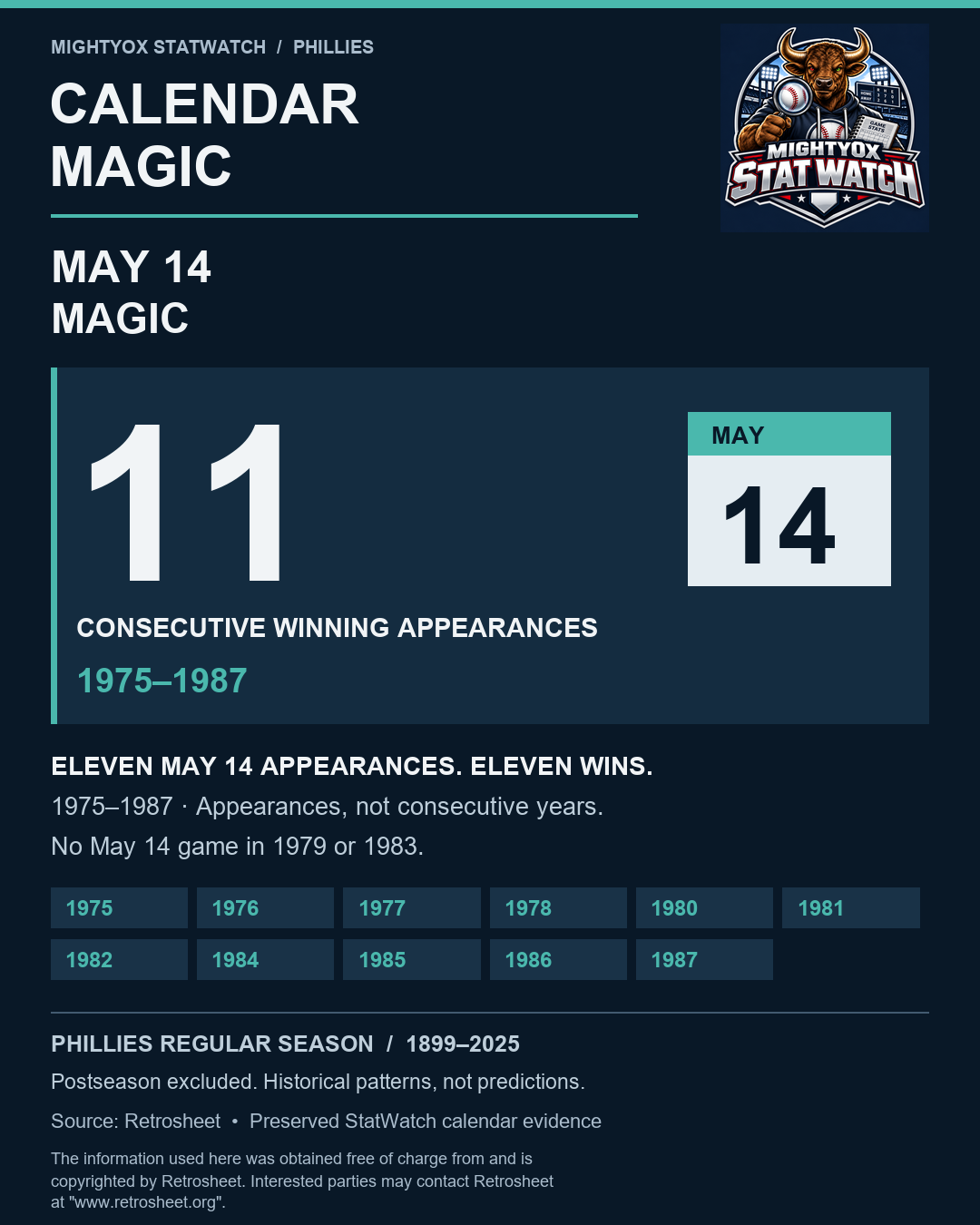
From 1975 through 1987, every Phillies appearance on May 14 ended in a win. Two missing dates make the counting rule part of the story.
Published · October 16, 2026
For a stretch of Phillies history, May 14 kept delivering a win. Philadelphia won on eleven consecutive appearances on that date, beginning in 1975 and ending in 1987. The endpoints are farther apart than the number eleven suggests. There were no Phillies games on May 14 in 1979 or 1983 in the qualified record, so this is an appearance streak, not eleven consecutive calendar years.
The sequence opened with a 4–0 home win over Cincinnati in 1975. A year later, the Phillies won 5–1 at Houston. They beat San Diego 9–5 in 1977 and Cincinnati 7–4 in 1978. Those first four results show the variety hidden by a simple string of wins: the final scores differ, even when the outcome does not.
After the first skipped date, Philadelphia won 9–1 at Atlanta in 1980. The next two qualifying appearances both came against San Francisco: a 3–1 road win in 1981 and a 2–0 home win in 1982. No inning details or individual pitching performances are needed to see that the scoring profiles changed from game to game.
The last four appearances added wins over Los Angeles, Cincinnati twice, and Atlanta. Three were particularly close: 3–2 against the Dodgers in 1984, 8–6 against the Reds in 1986, and 5–4 against the Braves in 1987. Across the entire eleven-game run, the Phillies scored 62 runs and allowed 25. That is a sum of final scores, not a claim about how any of those games unfolded.
The neighboring dates place limits around the finding. Philadelphia lost 9–2 to Montreal on May 14, 1974, and lost 3–2 to Los Angeles on May 14, 1988. The winning appearances between those losses form the closed sequence shown in the table. Each of its eleven dates contains one game; no doubleheader changes the count.
Calendar Magic is a name for the pattern, not a theory about what caused it. The comparison covers qualified Phillies regular-season records from 1899 through 2025, using original source-assigned dates. Postseason games and provisional records are excluded. The point is to enjoy an unusual historical run while keeping its definition intact: eleven appearances, eleven wins, with two calendar gaps.
CHECK THE RECORD
Phillies regular season1899–2025; postseason excluded
| Date | Opponent | PHI–Opp. | Result |
|---|---|---|---|
| 1975-05-14 | Cincinnati Reds | 4–0 | W |
| 1976-05-14 | Houston Astros | 5–1 | W |
| 1977-05-14 | San Diego Padres | 9–5 | W |
| 1978-05-14 | Cincinnati Reds | 7–4 | W |
| 1980-05-14 | Atlanta Braves | 9–1 | W |
| 1981-05-14 | San Francisco Giants | 3–1 | W |
| 1982-05-14 | San Francisco Giants | 2–0 | W |
| 1984-05-14 | Los Angeles Dodgers | 3–2 | W |
| 1985-05-14 | Cincinnati Reds | 7–1 | W |
| 1986-05-14 | Cincinnati Reds | 8–6 | W |
| 1987-05-14 | Atlanta Braves | 5–4 | W |
Original source-assigned dates govern. Calendar-year streaks require adjacent years; appearance streaks skip years without an appearance. All relevant games on a date must qualify. Adjacent boundaries and source-row references are retained in the evidence.
The information used here was obtained free of charge from and is copyrighted by Retrosheet. Interested parties may contact Retrosheet at "www.retrosheet.org".
Source organization · Detailed source records are retained for verification and corrections.
Historical patterns are not predictions. No unsupported player actions, quotations or inning-by-inning details are inferred.
Published after factual and editorial review. Correction policy and version notes.
Calendar Curse
Nine years. Nine games. Nine losses. A calendar coincidence with an unusually stubborn streak.
Calendar Curse
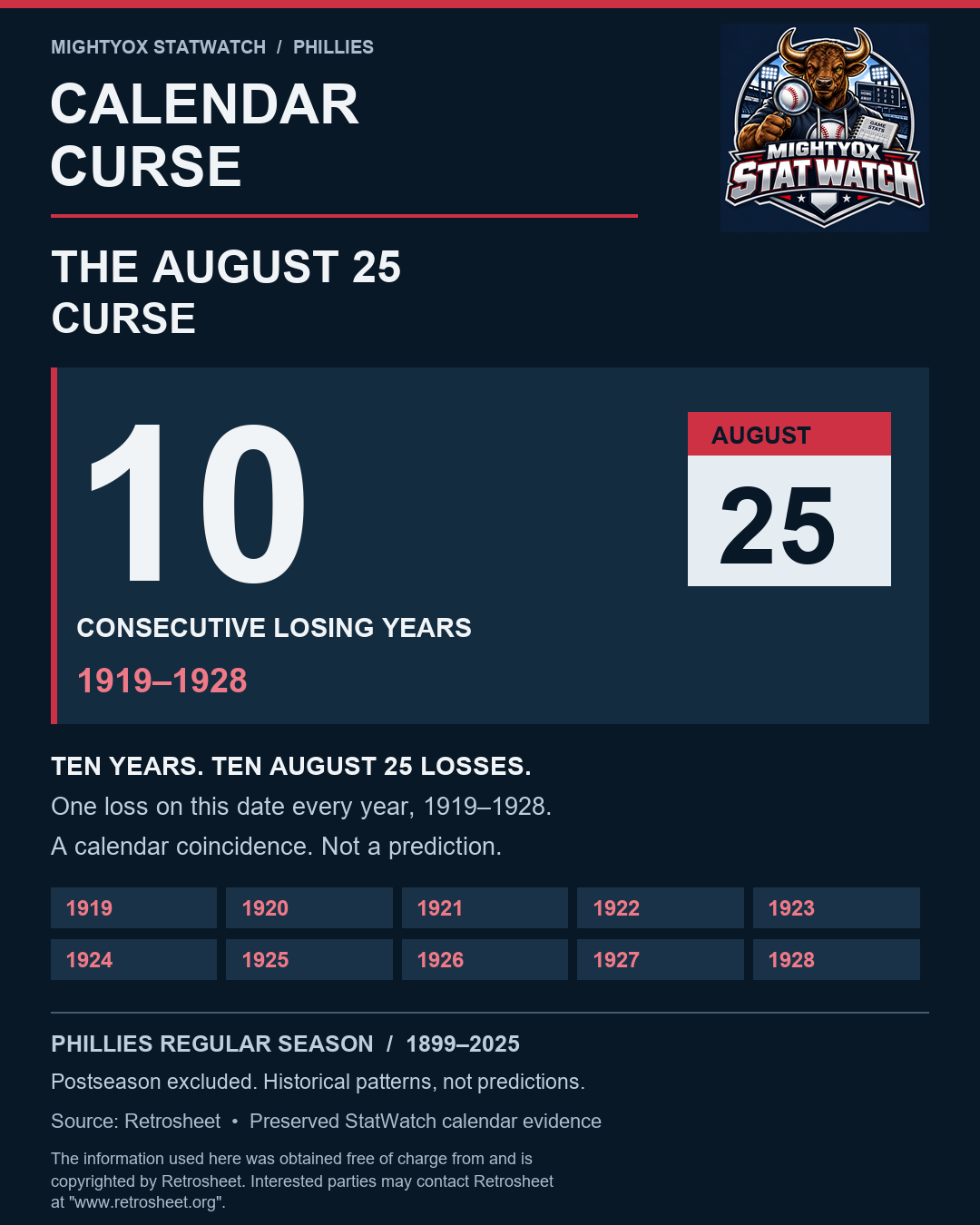
From 1919 through 1928, the Phillies lost on August 25 every year—even when they scored 23 runs.